Stop Oil Creep in Its Tracks: The Complete Guide to XYC Bar Type T
Have you ever designed or maintained a high-precision mechanical assembly, only to find that your expensive lubricating grease mysteriously crept away from the bearing and ruined surrounding electronics or optical lenses?
Lubricating oils and greases naturally want to migrate, bleed, and creep across metal, glass, or plastic surfaces. When they wander into sensitive areas, component failure follows closely behind. This is precisely why XYC Bar Type T exists.
What Is XYC Bar Type T?
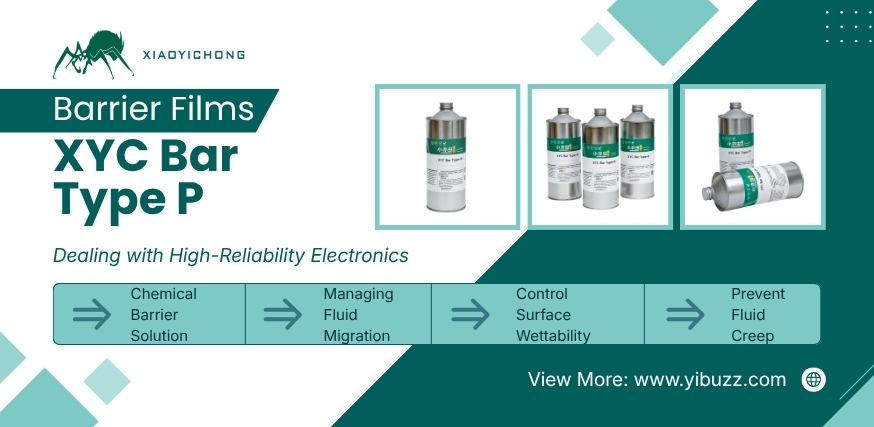
Manufactured by XiaoYiChong (a Fuchs Group company), XYC Bar Type T is not a lubricant. Instead, it is an advanced oleophobic (oil-repelling) barrier film.
When applied to a component, it creates a micro-thin boundary with an ultra-low surface energy of roughly 10 dynes/cm. When a migrating drop of oil hits this barrier, it stops dead in its tracks and beads up like water on a freshly waxed car.
Key Technical Specifications
- Active Chemistry: Stable fluorocarbon polymer.
- Solvent Carrier: Fast-evaporating perfluoropolyether solvent (boiling point approx. 55℃.
- Concentration Options: Available in 0.2%, 1.0%, and 2.0% active weight options to control film thickness.
- Temperature Stability: Operates reliably up to +200℃.
- Appearance: Clear, colorless liquid solution.
- Solvent Carrier: Fast-evaporating perfluoropolyether solvent (boiling point approx. 55℃.
- Concentration Options: Available in 0.2%, 1.0%, and 2.0% active weight options to control film thickness.
- Temperature Stability: Operates reliably up to +200℃.
- Appearance: Clear, colorless liquid solution.
Where Should You Use It?
- Bearings & Actuators: Applied as a perimeter barrier ring to keep grease sealed tightly inside housing seats and pivot points.
- Optics & Precision Cameras: Utilized near lenses and prisms to protect optical glass from image-distorting oil films (famously trusted on space-exploration rover cameras).
- Electrical Switches & Connectors: Painted around printed circuit boards and potentiometers to prevent creeping oils from fouling electrical contacts.
- Optics & Precision Cameras: Utilized near lenses and prisms to protect optical glass from image-distorting oil films (famously trusted on space-exploration rover cameras).
- Electrical Switches & Connectors: Painted around printed circuit boards and potentiometers to prevent creeping oils from fouling electrical contacts.
Application Best Practices
1. Clean Thoroughly: The target surface must be free of all oils and contaminants before application.
2. Apply with Precision: Dip, spray, or brush the solution in a ring surrounding the friction zone.
3. Never Lubricate Over It: Crucial Rule: Never apply XYC Bar directly to active contact friction points (like bearing balls or active electrical pathways) that require lubrication, or the component will run dry.
4. Curing Options: Air dries in 5 minutes at room temperature. For enhanced durability, bake for 10 minutes at 90℃, or for 2 hours at 120℃ to meet low-outgassing vacuum requirements.
2. Apply with Precision: Dip, spray, or brush the solution in a ring surrounding the friction zone.
3. Never Lubricate Over It: Crucial Rule: Never apply XYC Bar directly to active contact friction points (like bearing balls or active electrical pathways) that require lubrication, or the component will run dry.
4. Curing Options: Air dries in 5 minutes at room temperature. For enhanced durability, bake for 10 minutes at 90℃, or for 2 hours at 120℃ to meet low-outgassing vacuum requirements.

Some information is sourced from the internet; if there is any infringement, please contact us.
Precision Containment: Understanding XYC Bar Type P Barrier Films
Unravel the Science of High-Performance Lubricants: XYC LGLT 2/1 and XYC LGHP 2/1
Related blog