Precision Containment: Understanding XYC Bar Type P Barrier Films
When dealing with high-reliability electronics, sensitive fluidic systems, or specialized aerospace equipment, managing fluid migration is a critical engineering challenge. Even microscopic amounts of creeping oil can cause environmental fouling or electrical short circuits.
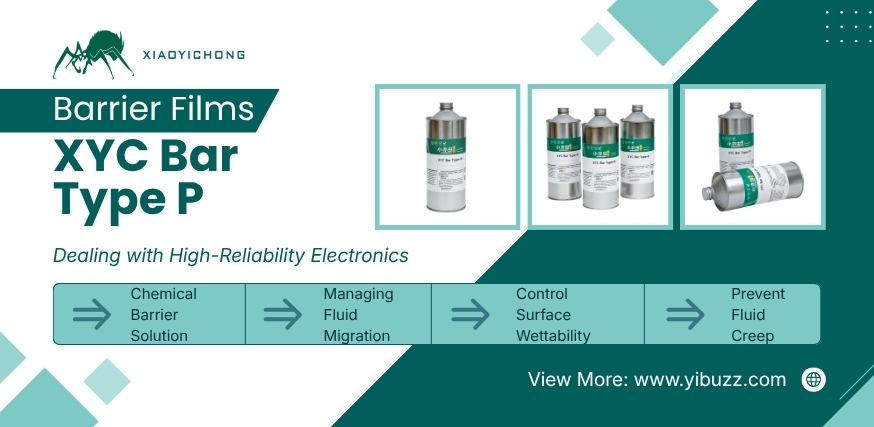
To solve this, engineers turn to XYC Bar Type P—a specialized chemical barrier solution designed to control surface wettability and stop fluid creep at the microscopic level.
What Makes XYC Bar Type P Unique?
Like its counterpart, XYC Bar Type P is a stable fluorocarbon polymer dissolved in a fast-evaporating solvent carrier. However, Type P is specifically formulated to meet precise aerospace, defense, and industrial standards that require exact solvent evaporation profiles and stringent material compatibility.
When the carrier solvent flashes off, it leaves behind an invisible, non-tacky fluorocarbon film that drastically lowers the surface energy of treated areas, preventing oils and silicones from "wetting" and spreading across the solid surface.
Technical Profile at a Glance
- Solvent Type: Fast-evaporating fluoroalkane carrier (boiling point approx. 61℃.
- Density: 1.7 g/ml at room temperature.
- Contact Angle: Approximately 68℃ to 75℃, ensuring robust fluid repulsion.
- Concentration Levels: Offered in 0.2%, 1%, and 2% weight concentrations to dial in the exact barrier thickness required for your application.
- Thermal Range: Capable of withstanding continuous operational environments up to +200℃.
- Density: 1.7 g/ml at room temperature.
- Contact Angle: Approximately 68℃ to 75℃, ensuring robust fluid repulsion.
- Concentration Levels: Offered in 0.2%, 1%, and 2% weight concentrations to dial in the exact barrier thickness required for your application.
- Thermal Range: Capable of withstanding continuous operational environments up to +200℃.
Primary Industrial Applications
- Aerospace & Defense: Widely specified for instruments and actuators where fluid containment under vibration or variable gravity is critical.
- Fluidics & Dispensers: Applied to fluid dispensing nozzles, spray heads, and automated oiling applicators to stop liquids from creeping up nozzle shafts and ruining spray patterns.
- Printed Circuitry: Used as an environmental barrier to prevent oil migration from fouling sensitive electrical boards and connectors.
- Fluidics & Dispensers: Applied to fluid dispensing nozzles, spray heads, and automated oiling applicators to stop liquids from creeping up nozzle shafts and ruining spray patterns.
- Printed Circuitry: Used as an environmental barrier to prevent oil migration from fouling sensitive electrical boards and connectors.
Handling and Curing Guidelines
- Application Methods: Easily applied via automated dipping, targeted spraying, or localized hand brushing.
- Thermal Bake Option: For high-vacuum or high-purity applications, parts treated with Type P can be heat-baked to optimize outgassing reduction.
- Important Warning: Type P creates a non-wettable surface. Care must be taken during mask manufacturing or template application to ensure the barrier forms only a perimeter dam and never enters zones that require active lubrication.
- Thermal Bake Option: For high-vacuum or high-purity applications, parts treated with Type P can be heat-baked to optimize outgassing reduction.
- Important Warning: Type P creates a non-wettable surface. Care must be taken during mask manufacturing or template application to ensure the barrier forms only a perimeter dam and never enters zones that require active lubrication.
Some information is sourced from the internet; if there is any infringement, please contact us.
Mastering the Vacuum: The Guide to the XYC TORR High-Performance Lubricant Series
Stop Oil Creep in Its Tracks: The Complete Guide to XYC Bar Type T
Related blog