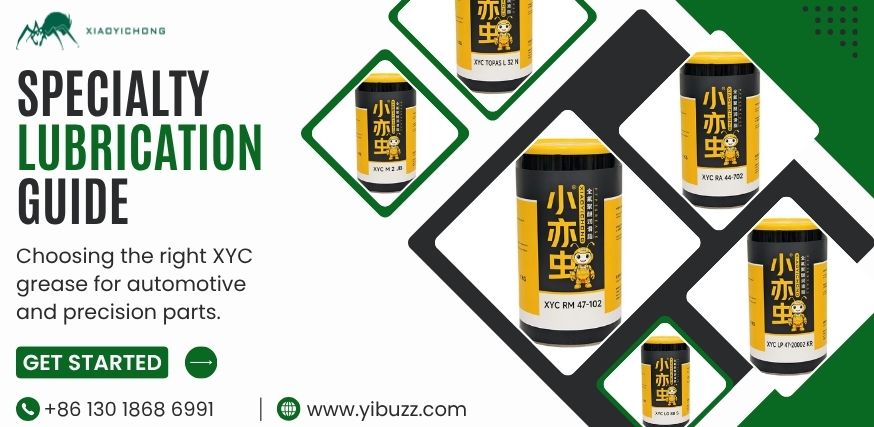
Choosing the Right XiaoYiChong Precision Electronics & Optical Lubricant
|
Product Number |
Physical Form |
Primary Use Case |
Standout Feature |
|---|---|---|---|
|
XYC G-313S |
Quick-Dry Fluid / Dry-Film |
Optical tracks, delicate lenses, sliders |
Zero dust attraction; flashes dry instantly. |
|
XYC G-31SA |
True Mechanism Grease |
Camera lens helicoids, precision gears |
Perfect manual focus dampening; zero lens fogging. |
|
XYC G-424Z |
Heavy Damping Grease |
Audio mechanisms, loose gears, switches |
Elite noise silencer and heavy vibration dampener. |
|
XYC G-741 |
High-Speed Mechanism Grease |
Micro-motors, cooling fans, spindles |
Non-diffusive; won't spin off fast-spinning shafts. |
|
XYC KG-107A |
Lightweight Slider Grease |
Printer carriage rails, scanner tracks |
Ultra-low friction; extreme plastic compatibility. |
- Best For: Exposed mechanical tracks, delicate slider components, and environments prone to heavy dust or debris.
- Why It Wins: Unlike traditional wet grease, G-313S is designed to flash dry almost instantly upon application. Because it leaves behind a dry, micro-thin barrier, it completely eliminates the risk of oil migration. It is heavily utilized where traditional wet oils would attract dust or bleed outward to contaminate nearby optical paths.
- Best For: Manual and auto-focus camera lens barrels, helicoids, and high-precision electronic switches.
- Why It Wins: While it shares a pedigree with the G-313S fluid, G-31SA is a true structural paste. It is famously specified under OEM part numbers (like Canon Part DY9-3041) for lens servicing. It leverages XiaoYiChong's elite non-diffusive tech, ensuring that microscopic oil vapor never separates to fog up glass lenses, while offering a premium, buttery-smooth tactile resistance when turning focus rings.
- Best For: High-end audio gear, headphones, volume knobs, and noisy plastic-on-plastic gears.
- Why It Wins: If your mechanism chatters, clicks, or vibrates, G-424Z is the cure. Engineered specifically as a noise-elimination compound, this heavy grease absorbs impact and micro-vibrations. It cushions loose mechanical tolerances, giving structural components a high-end, heavily dampened operational feel while remaining completely chemically inert against plastic degradation.
- Best For: Miniature cooling fans, micro-vibration motors, appliance motor shafts, and spindle axes.
- Why It Wins: Fast-spinning miniature shafts generate centripetal force that easily flings standard greases away, leaving the bearing dry and prone to burning out (coking). G-741 features a unique anti-spinning, non-diffusive molecular matrix. It locks itself onto the fast-turning shaft core, providing exceptional wear protection and massive noise reduction over a lifetime of use without bleeding onto surrounding electronics.
- Best For: Inkjet/laser printer carriage guide rails, flatbed scanner tracks, and document feeder hinges.
- Why It Wins: Officially recognized in major printer service catalogs (such as Canon Part QY9-0057-000), KG-107A is built for continuous, rapid, back-and-forth sliding movements.
- Fixing a premium camera lens focus ring? Choose G-31SA.
- Trying to kill a loud mechanical noise or vibration? Choose G-424Z.
- Lubricating a fast-spinning fan or tiny motor? Choose G-741.
- Servicing a printer carriage rail or scanner slider? Choose KG-107A.
Follow these professional steps to get factory-perfect results.
- The Technique: Use a lint-free microfiber swab or an ultra-dense foam tip.
- The Solvent: Moisten the swab with High-Purity Isopropyl Alcohol (99% IPA). Avoid lower percentages (like 70% rubbing alcohol) as they contain water that can trap moisture inside electronic parts or corrode miniature bearings.
- Execution: Gently wipe away all traces of the old, discolored lubricant until the plastic or metal substrate is completely clean and bone-dry.
- For Dry-Film (G-313S): Use a fine-tipped anti-static nylon brush or a specialized dipping tool. Because it is highly fluid before it evaporates, a brush allows you to paint an incredibly uniform, micro-thin layer across the track.
- For Greases & Damping Compounds (G-31SA, G-424Z, G-741, KG-107A): Use an industrial syringe with a blunt-tip needle (14G to 18G depending on thickness) or a lint-free polyurethane foam swab. Avoid standard cotton Q-tips, as they shed microscopic cotton fibers that will jam precision gears or show up inside camera lenses.
- Action: Do not pack or smother the gears or rails. Instead, use your syringe or foam swab to apply microscopic "dots" of grease at even intervals along the slider rail or on every third tooth of a gear mechanism.
- Distribution: Once the dots are applied, manually cycle the mechanism back and forth several times. The moving parts will naturally distribute a flawless, micron-thin layer across the entire interface. Any excess grease that squeezes out to the edges should be wiped away immediately.
- Action: Because damping grease is thick and designed to absorb physical vibrations, it requires a slightly more continuous coverage than standard grease.
- Distribution: Use a flat plastic spatula or a dense foam swab to apply a light, even film across the friction surface. Ensure there are no air bubbles trapped in the grease layer, as air gaps will cause inconsistent tactile feedback when turning a dial or adjusting an audio switch.
- Action: Treat G-313S like quick-drying paint. Dip your brush into the fluid and apply it to the surface in a single, smooth stroke.
- Curing Time: Do not move the mechanism immediately. Allow 30 to 60 seconds for the solvent carrier to completely evaporate (flash off). You will see the surface turn from a wet sheen to a completely dry, matte finish. Once dry, the invisible lubricating matrix is locked in place and ready for operation.
- Keep Containers Sealed: XYC containers should be capped tightly immediately after extracting what you need. This prevents airborne dust from contaminating your supply and stops the quick-dry solvents in G-313S from evaporating in the tin.

XiaoYiChong PFPE Grease — Uncompromised Reliability at a Great Value